Scott Mason
Essay #30 Nov/Dec 2025
[Editor’s Note: the following was excerpted from a presentation made by Scott Mason at the Haiku North America 2025 Conference in San Francisco this past September entitled “’Mr. Haiku’ A Lifetime of Discovery” — in tribute to the late Cor van den Heuvel. Heartily agreeing with Scott’s own words below — “There may be some lessons in all this for a haiku poet.” — I sought permission to excerpt and print the essay.]
… But first, let’s return to this curious remark — “I had been searching for the secret of turning words into things.” [Cor van den Heuvel — Memorial Lecture, Masaoka Shiki International Haiku Awards, 2002].
Those of you who know me well, know that I’m borderline obsessed with art, and that I’ve spent countless hours in galleries and museums — especially the Metropolitan Museum in New York. So random things will often trigger art associations for me. Cor’s quote here about transformation instantly brought to mind …
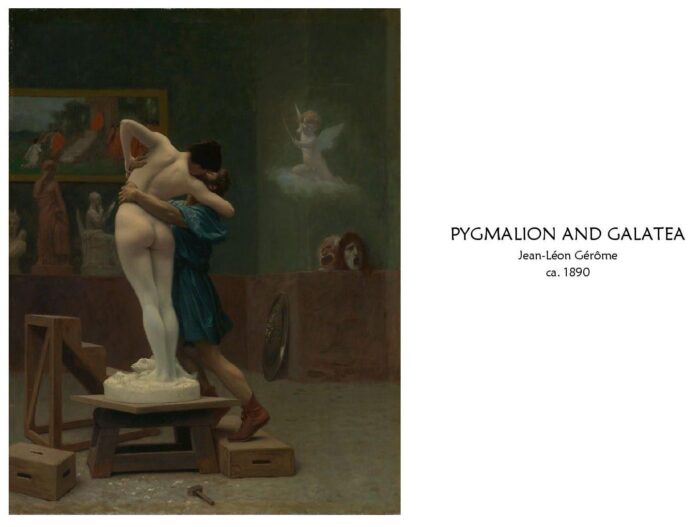
… this piece from the Met’s collection by the academic painter Jean-Léon Gérôme. It’s titled after and based on the Ovidian myth of the artist Pygmalion who wished for a wife as lovely as his sculpted creation; the goddess Aphrodite obliged and, presto, Galatea came alive.
But in reflecting further on this, I think there’s another work in the Met’s collection that comes far closer to the spirit of what Cor had in mind.
It’s this piece …
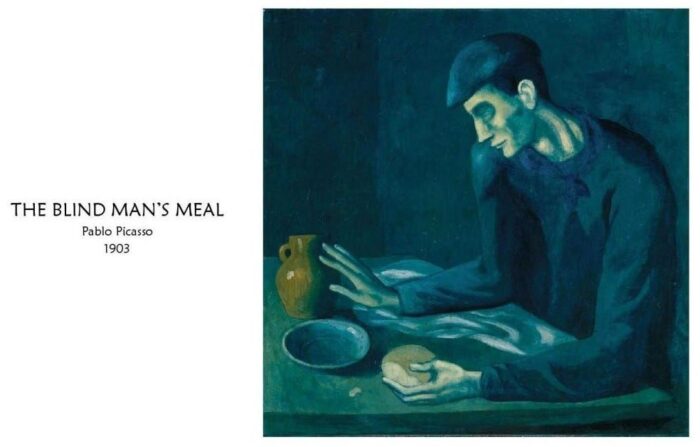
… titled “The Blind Man’s Meal” and painted by Picasso. It was produced just thirteen years later, during — as some of you may have already guessed — his Blue Period.
I think it’s both interesting and instructive to …
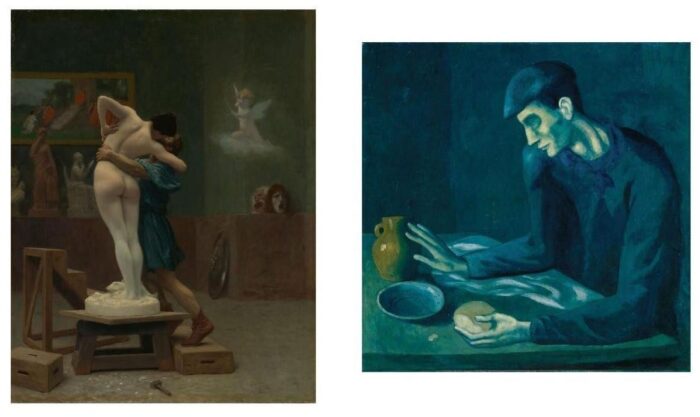
… compare and contrast these two.
Let me offer a few observations.
Despite their obvious stylistic differences, both scenes show movement — and, specifically, movement towards some form of, let’s call it, communion: a more carnal communion on the left and, on the right, one that feels more spiritual, complete with the sacramental elements of bread and wine.
The scene on the left features a more overt demonstration of emotion, indeed passion — and yet I find myself more emotionally engaged, and moved, by the scene on the right. Why would that be?
Part of it may have to do with perceived authenticity: on the left we’re seeing something that we know to be outside the natural order of things. It’s a clever conceit, but a conceit nonetheless. Everything I see and experience on the right feels both plausible and sincere.
An even bigger factor may be the role not of the protagonists but of the viewer. In both cases here, the viewer is unobserved: the protagonists on the left are obviously preoccupied, and the one on the right can’t see. But as a viewer of the scene unfolding on the left, I’m left feeling like an interloper or, worse, a voyeur. Galatea’s back is to me, and the signal seems clear. The man on the right is also unaware of my presence, but there’s an openness here in his bearing, in how he’s positioned, and even in his unadorned room. It’s a room, I sense, with room for me. Although the protagonist hasn’t invited me in, the artist has.
There may be some lessons in all this for a haiku poet.
But let me turn to my original focus. If I were to use a single word to characterize the scene on the left, it would be . . .
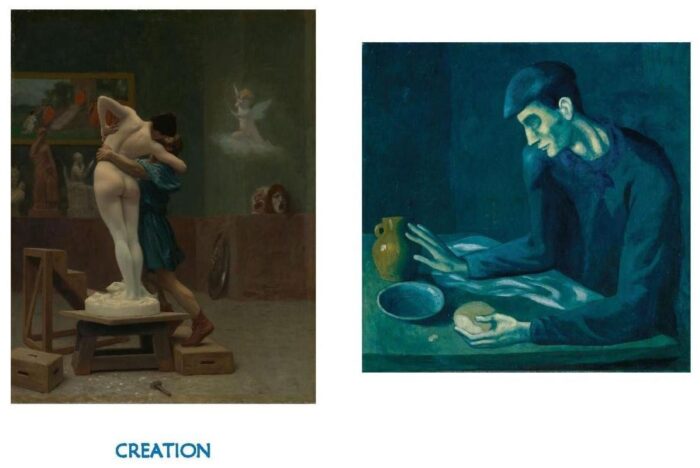
… CREATION. Here we have artistic creation merged with the creation of life. It’s a novel trick — but, once again, I feel left out.
On the right I feel …
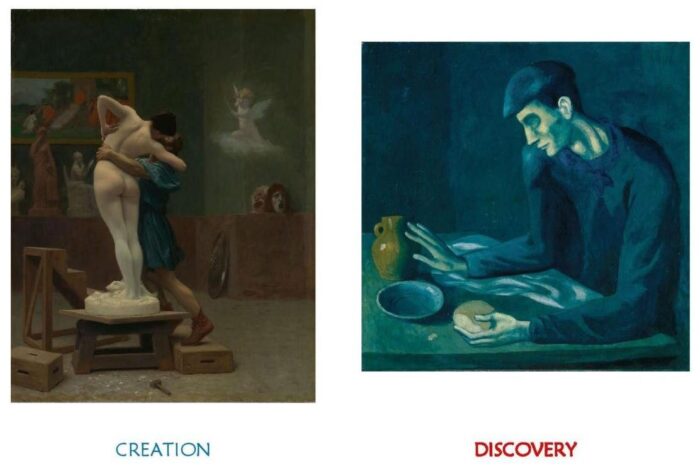
. . . there’s that word again: a sense of DISCOVERY. I sense it in the protagonist, but also in myself as a viewer. Here I’m entering the story in the middle, not at the climax (so to speak). And here I feel less like a witness than a participant.
So let me return now to Cor’s quote about “the secret of turning words into things.” Cor would more often describe the very same phenomenon by talking about haiku that possess what he called “an ontological thrust.” In that interview with Jim [Kacian] ten years ago, he said any such haiku “seems to put whatever is described in the poem actually before me. It’s almost as if I could knock on it as I might knock on my desk.”
Ontology is just a fancy term for the study of existence, or the nature of being. So let me now share with you my big ontological insight. It may even be a tautology. Here it is: There is no need to create existence. Why would that be? Because existence already exists.
But here’s the catch. We’re often oblivious to what exists around us, because we’re swimming in it. And that’s where discovery comes in. There are unlimited opportunities to notice, to appreciate, and to share with others what’s already here yet so often overlooked.
And to discover this world of ours — to see it with new eyes — one must, at times, enter blind. Zen Buddhists call that “beginner’s mind.”
Cor was not advocating for the creation of anything new but rather bringing alive our awareness and experience of what already exists. Haiku that do that have an “ontological thrust.” …
“Pygmalion and Galatea”
Jean-Léon Gérôme, ca. 1890
The Metropolitan Museum of Art Public Domain Open Access Policy
https://www.metmuseum.org/art/collection/search/436483
“The Blind Man’s Meal”
Pablo Picasso, 1903
© 2025 Estate of Pablo Picasso / Artists Rights Society (ARS), New York
https://www.metmuseum.org/art/collection/search/488596